
Building a Healthy Student Culture, FK UIN Jakarta Discusses AI, Academic Stress, and the Redesign of PBAK
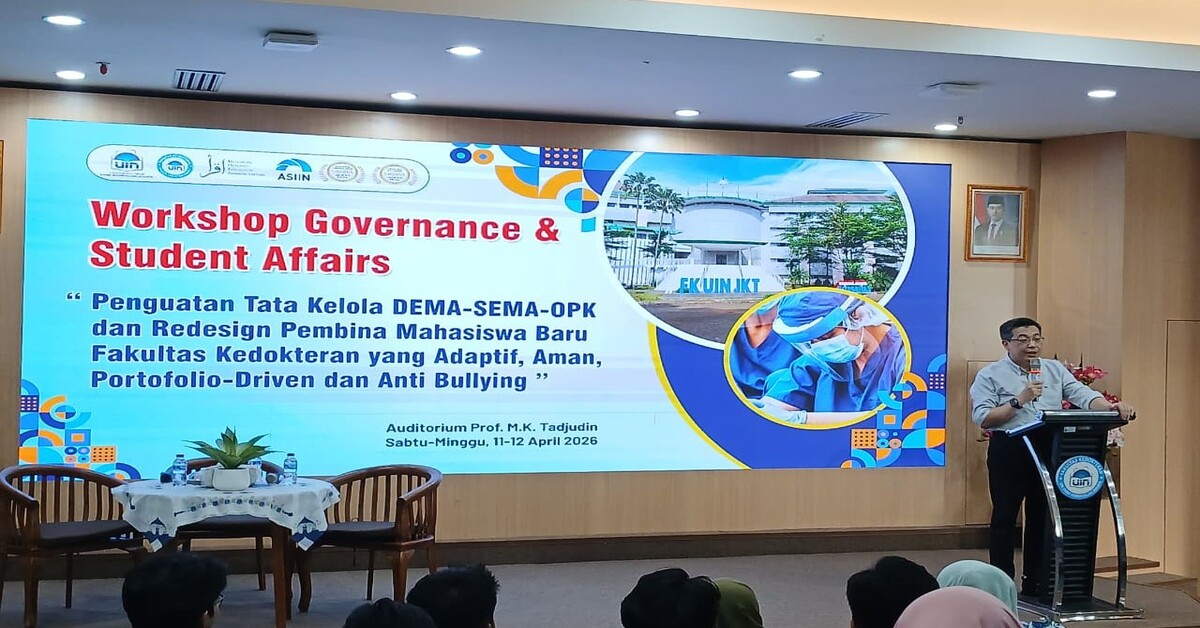
M.K. Tadjudin Auditorium, FK Online News – The Governance & Student Affairs Workshop of the Faculty of Medicine at UIN Syarif Hidayatullah Jakarta featured a number of national and international speakers to discuss various strategic issues in the lives of medical students, ranging from student competency development and mental health to the transformation of new student orientation activities, on Saturday, April 11, 2026.
In the first session, the Vice Dean for Academic Affairs, dr. Fika Ekayanti, M.Med.Ed., MARS, presented the topic “Beyond the Curriculum,” highlighting the importance of understanding the hidden curriculum in medical education.
“The hidden curriculum is real. The way we interact, organizational culture, and even the pressures we experience all shape the character of future doctors,” she explained.
She also highlighted the high level of stress experienced by medical students and the importance of maintaining their initial motivation in pursuing the profession.
“Amid academic pressure, it is important to return to our original intention: why we want to become doctors,” she said.
In addition, dr. Fika discussed technological developments in student learning, including the use of artificial intelligence.
“Around 73% of students are already using AI in their learning process. This is both an opportunity and a challenge that we must manage wisely,” she added.
The next session featured Dr. Gianisa Adisaputri, MD, M.Emerg.Mgt., PhD, who shared her experience of studying abroad, particularly regarding student organization systems at the international level.
“Abroad, student unions and student societies play a very strong role in supporting student welfare and development,” she said.
She also emphasized the importance of building a portfolio early and using student organizations as a means of self-development and global networking.
“Students need to be encouraged to actively build their portfolios from the very beginning, because this is key to accessing various opportunities, including international scholarships,” she explained.
Meanwhile, in the session titled “From ‘Ospek’ to Onboarding: Redesigning Supportive PBAK,” dr. Zata Yudha Amaniko, Sp.OG, and Mahmudi Syarif Ridho highlighted the importance of transforming campus orientation activities into something more educational and more focused on building a healthy organizational culture.
“PBAK must become an onboarding process that humanizes new students, not an arena for displaying hierarchy. This is where the values of a healthy organization begin to take shape,” said dr. Zata.
Mahmudi added that student organizations play an important role in shaping students’ early experiences.
“Student development activities must be designed to introduce organizations in a positive way, so that new students feel they have a space to grow, both as student organizers and as those who are not directly involved in organizations,” he explained.
The discussion, moderated by dr. Naufal Al Hakim Salsabila, reinforced the direction of new student development toward a model that is more inclusive, adaptive, and free from bullying practices, while also encouraging stronger governance of student organizations within the Faculty of Medicine at UIN Jakarta.
(AAS/NIS)