
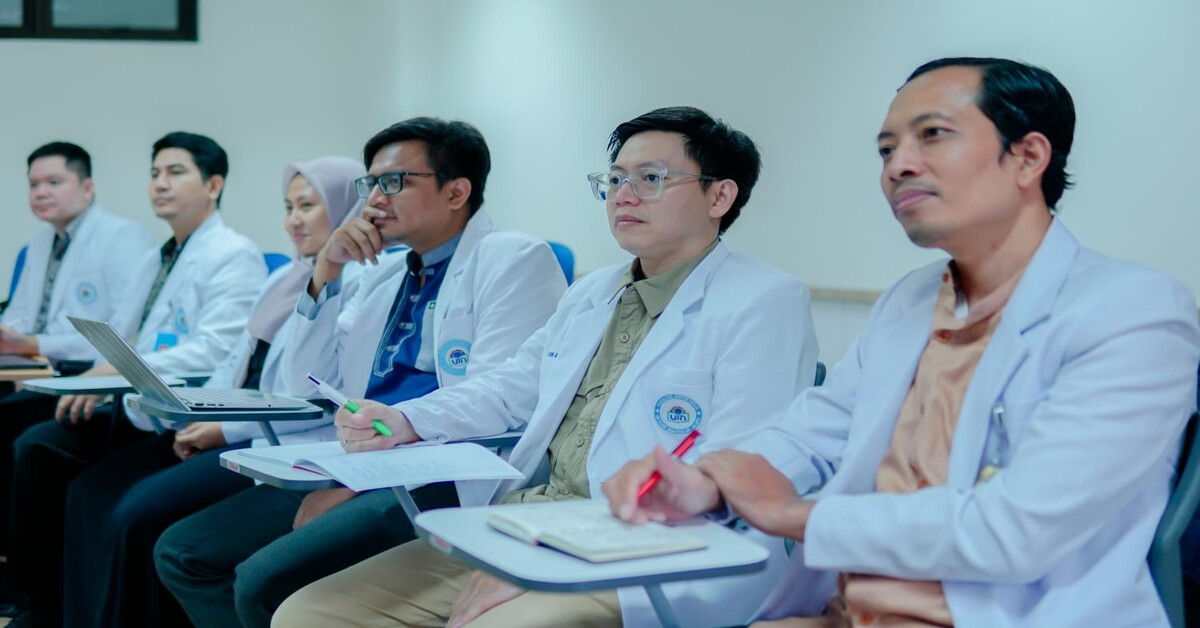
FK UIN Jakarta Integrates Discipline into the Development of Professional Doctors
FK News Online – The Medical Doctor Professional Program is an advanced stage of medical education following students’ preclinical training. At the Faculty of Medicine, UIN Syarif Hidayatullah Jakarta, the professional program involves an intensive learning process lasting approximately 88 weeks. It consists of 19 modules and is conducted across various hospitals and clinical training sites. Head of the Medical Doctor Professional Program, dr. Risahmawati, Ph.D., explained the structure, academic workload, learning system, and clinical practice implemented in the professional medical education program at UIN Jakarta.
In her explanation, dr. Risahmawati, Ph.D., stated that FK UIN Jakarta implements a rigorous evaluation system and academic requirements, including cumulative grade point average (GPA) evaluations, clinical skills examinations, and requirements that must be fulfilled before students can take the national competency examination. She also explained that professional medical education is an integral continuation of preclinical education for medical students.
“Professional education, as Dr. Fika explained earlier, is an inseparable part of preclinical education. It is completed over four semesters, with a maximum duration of 10 semesters,” she explained.
She also emphasized that the maximum duration of 10 semesters should not be interpreted as an expectation for students to complete the program in 10 semesters. Instead, students are encouraged to complete their education within the designated period.
“The modules are also quite extensive. There are 19 modules, consisting of five major or long modules, 11 minor modules, and three local-content modules integrated with Integrated Muslim Doctor and Bioethics (IMDB),” she explained.
With the professional medical education workload reaching approximately 70 credits, dr. Risahmawati emphasized the importance of support from those around the students. “This education lasts approximately 88 weeks. It can be said to be almost without a break. Therefore, students need physical, mental, and financial preparation,” she explained.
Professional medical education is not limited to classroom learning. Students also undertake learning activities in hospitals, inpatient wards, emergency rooms, and communities. The learning methods include case discussions, bedside teaching, patient education, home visits, and clinical skills practice.
Through the learning experience and professional education system implemented across various teaching hospitals, both within and outside Jakarta, dr. Risahmawati emphasized that the professional education program remains closely connected to preclinical education. “Our educational concept extends from Grogol to Cisarua, Puncak,” she explained.
In addition, FK UIN Jakarta supports student mobility through exchange programs facilitated by the faculty. “There is also an elective module in the form of exchanges, including independent exchanges, programs supported by student organizations such as CIMSA or IFMSA, as well as you-to-you exchanges,” she explained.
“There is also funding for students who participate in these activities. They can carry out certain activities and have them recognized as elective modules. The requirement is that they complete the module. There are specific skills, activities, and reports that students must fulfill,” she added.
The faculty also conducts periodic academic evaluations in the second, fourth, and sixth semesters. Students with a GPA below 2.5 will receive further academic attention. As medical students at UIN Jakarta are required to fulfill specific requirements before being registered for the national competency examination, these requirements include passing the Computer-Based Test (CBT) and Objective Structured Clinical Examination (OSCE), as well as participating in the progress test at least twice.
“The reason is that we want to ensure the quality of education and make sure that students meet the required standards before continuing to the next stage,” she concluded.
(MA/NIS)