
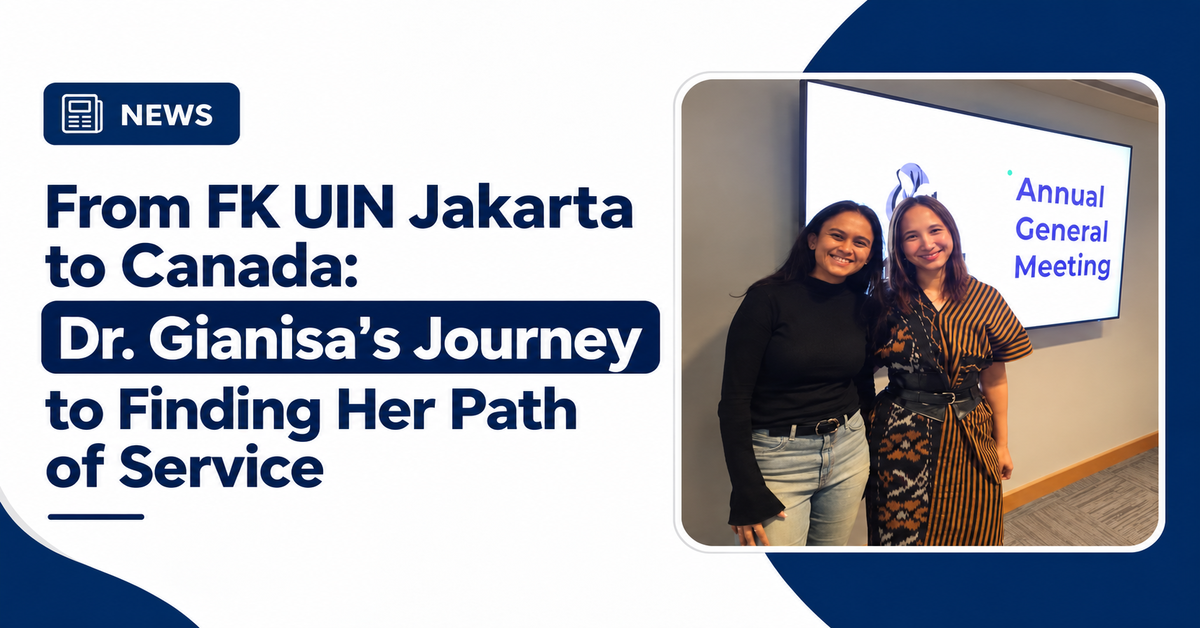
From FK UIN Jakarta to Canada: Dr. Gianisa's Journey to Finding Her Path of Service
Medical Faculty Building, FK Online News – For Dr. Gianisa Adisaputri, MD, M.Emerg.Mgt., PhD, becoming a doctor does not mean that one's journey must be confined to clinical practice or lead exclusively to medical specialization. Her academic and professional journey has taken her across various fields, from medicine and emergency management to resilience, population health, and health services research in Canada.
Her journey began when Gianisa was in her final year of high school. As she started considering her university options, she already knew one thing she wanted to pursue: medical school. She began exploring several medical faculties in Jakarta and other cities.
At the time, her father, a professor at the University of Indonesia, suggested that she consider the newly established Faculty of Medicine at UIN Syarif Hidayatullah Jakarta. Her father knew Prof. Tajudin and was familiar with his reputation. In addition, UIN Jakarta's medical program had established collaborations with the University of Indonesia and several partners in Japan.
These considerations eventually led Gianisa to apply. She was admitted through the STMD admission pathway and had placed FK UIN Jakarta as her first choice from the beginning. Little did she know that this decision would become an important part of her life's journey.
Dr. Gianisa as Part of the Pioneering Generation
When Gianisa enrolled, FK UIN Jakarta was still in its early stages of development. With a relatively small student population, relationships among students, senior students, lecturers, and faculty members were particularly close. For her, this environment became one of the faculty's greatest strengths.
She recalled receiving tremendous support from the university community, especially when facing various challenges throughout her medical education and clinical rotations.
"If I hadn't studied at UIN, I wouldn't have received the kind of support I experienced there," she recalled.
Her medical education was not always an easy journey. There were moments when she felt overwhelmed and even considered giving up. The pressures of medical school, hospital responsibilities, and various personal challenges once led her to contemplate leaving medical education altogether. However, the support of her friends, senior students, and faculty members encouraged her to persevere.
Years later, she realized that this support had meant much more than simply helping her complete her studies. The social bonds and sense of belonging to her alma mater became some of the most meaningful aspects of her university experience, which she continues to cherish today.
When asked about her most memorable experience during medical school, Gianisa could not identify just one particular event. For her, the most meaningful aspect was the social connection and continuous support she experienced throughout her education.
"I can't name just one moment because I felt that connection and support throughout my entire time at university. The support and connections I experienced were always constant," she said.
From Medicine to Disaster Management
After completing her medical education, Gianisa took a path that might initially have seemed unconventional compared to the traditional medical career trajectory. She pursued further studies in emergency management in New Zealand.
For Gianisa, medicine and disaster management are not entirely separate disciplines.
In disaster situations, doctors and healthcare professionals are expected not only to provide medical services but also to make decisions, manage resources, lead teams, and determine appropriate responses under challenging and resource-limited circumstances.
She illustrated this with a simple example. When flooding occurs and a temporary medical post needs to be established, the challenge is not merely determining which doctors will be deployed. Other important considerations include the location of the medical post, necessary equipment, the number of healthcare workers, medication supplies, and how all these resources should be managed.
"So, it's not just practical clinical skills that we need, but also leadership and the ability to manage disaster situations," she explained.
As a doctor, she felt that her medical education had equipped her with clinical knowledge and practical skills. However, to make a broader contribution to society, she recognized the need to understand how emergency situations are managed.
"I felt that, as a doctor, my medical education had taught me the practical side of medicine. But to contribute more to society, I believed that management was an aspect I needed to learn," she said.
Moving to Canada and Discovering the World of Research
After completing her studies in emergency management, Gianisa moved to Canada. There, she worked as a research assistant alongside academics focusing on resilience development among children, adolescents, and adults.
Her background in medicine and emergency management proved highly relevant to resilience research. This experience opened new opportunities and eventually led her to pursue doctoral studies.
Gianisa went on to pursue her PhD at Dalhousie University in Canada. During her academic journey, she became involved with the Resilience Research Centre within the Faculty of Health. Her name subsequently appeared in several studies examining resilience, healthcare access, public health, and the experiences of populations facing various barriers to accessing essential services.
One study involving Gianisa explored young people's experiences of accessing health and social support services in Drayton Valley, Canada. The research was published in The British Journal of Social Work in 2025.
Another study, conducted with Michael Ungar, examined changes in the professional identities of Indonesian doctors during the COVID-19 pandemic. The study explored how the pressures of the pandemic influenced healthcare professionals' professional identities while identifying factors that helped them adapt and maintain their well-being.
Medicine provided her with an understanding of patients and clinical practice. Emergency management introduced her to leadership and crisis management. Meanwhile, population health, resilience, and health services research enabled her to examine healthcare from a broader perspective.
Today, she applies these experiences to her research within the Canadian healthcare system. She is involved in health services research, focusing on various populations and communities, including children, adolescents, women, immigrants, and rural populations.
In 2026, the Canadian Institutes of Health Research also recognized Gianisa as part of the Health System Impact Fellowship program at Dalhousie University and IWK Health. Her work focuses on developing an equity-oriented healthcare quality improvement evaluation framework that incorporates the experiences of underserved populations and frontline healthcare professionals.
Maintaining Strong Connections with FK UIN Jakarta
Although her academic journey has taken her far from Indonesia, Gianisa has maintained her connection with FK UIN Jakarta.
She continues to follow and participate in academic activities organized by the faculty. During one event in 2026, Gianisa shared her experiences of studying abroad, international student organization systems, the importance of building a portfolio early, and how students can leverage organizational involvement to establish global networks.
"What I remember most is the social connection and support I received," she said.
This enduring connection has also motivated her to share the knowledge and experiences she has gained overseas with students at FK UIN Jakarta.
She wants students to understand that opportunities for personal and professional growth do not always take the same form. Such opportunities may involve pursuing further education, conducting research, building international networks, or entering fields they may never have previously considered.
Ultimately, Gianisa's message to FK UIN Jakarta students is simple: do not limit your future too early based on a single vision of what it means to become a doctor.
"Think outside the box," she advised.
She emphasized that medical students often have a very clear picture of their future: graduating, becoming doctors, pursuing specialist training, and eventually establishing clinical practices. While this pathway remains a valuable option, it is certainly not the only one.
Starting as a medical student at FK UIN Jakarta, Gianisa continued her education in emergency management, entered the world of research, pursued a PhD, explored population health and resilience, and eventually became involved in health services research in Canada.
For Gianisa, not every answer about the future needs to be found from the very beginning. What matters most is having the courage to explore new opportunities, embrace the process, and remain open to new possibilities that emerge along the way.
As her own journey demonstrates, medical education is not a path leading to just one destination. There are many directions one can pursue, and each offers its own meaningful way to contribute to society.

(AAS/NIS)