
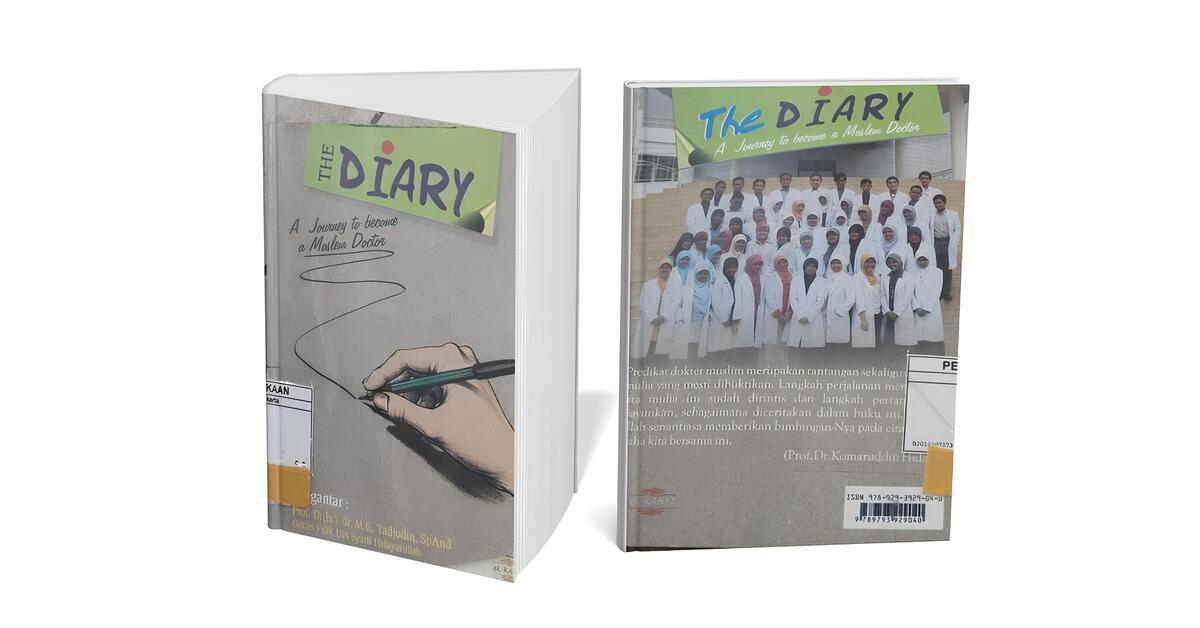
Reviewing The Diary: A Journey to Become a Moslem Doctor, the Journey of FK UIN Jakarta Alumni Toward Becoming Professional Muslim Doctors
FK, FK UIN Online News – Alumni of the Faculty of Medicine (FK) at Syarif Hidayatullah State Islamic University (UIN) Jakarta published a book entitled The Diary: A Journey to Become a Moslem Doctor. The book recounts the true stories of the first cohort of UIN Jakarta medical students as Muslim doctors, serving as a reflection on life and humanitarian struggles. Its second edition was released on January 11, 2011, to commemorate the first graduation ceremony of UIN Jakarta's medical students.
Independently published by the Association of Muslim Doctors Alumni of UIN Jakarta, with support from the Taajul Ilmi Mosque at FK UIN Jakarta, the book brings together stories of Muslim doctors striving to integrate Islamic values, scientific knowledge, and Indonesian identity into their professional practice. By sharing the joys and challenges of their work, the book demonstrates that becoming a professional Muslim doctor involves far more than studying modules on the integration of Islamic values, empathy, and bioethics for just a week or two.
The Diary: A Journey to Become a Moslem Doctor was written by 27 authors: Arum Widi Sarastuti, Awab Zakie Habibie, Dadan Dani H, Donny Alpha Edison, Haritsah, Ika Handayani S, Ira Susanti Haryoso, Kholidatul Husna, Moh. Edi Sutanto, Nita Nuranisa, Rizki Rizal, Syafiq Hasan Futhuri, Syahdi Farqani, Ana Raudah Al Jannah, Balgiz Al Zagladi, Desra Novianto, Eka Evia R. Agustina, Husna Lathiifa, Ika Triayunika, Jajang Marjaya, Laeli Puspita Sari, Mustika Anggiane P, Ratih Ayu Kusumasari, Sakinah Ginna R, Suci Sri Rahayu, Umu Istiqomah, and Yasin. The book was supported by several editors, including Ahmad Azwar Habibi, Ana Raudah, Arum Widi Sarastuti, Awab Zakie Habibie, Eka Evia R. Agustina, and Sakinah Ginna R.
The book is divided into several sections. Part One presents stories under the theme “Memorable Lessons from the Muslim Doctor and Empathy Module.” Part Two is entitled “Should I Leave the Second One Behind,” while Part Three is titled “It Seems Easy, but It Turns Out to Be Difficult.” Part Four contains “Small Things That Make a Big Difference” and “Inspirational Stories,” and Part Five is entitled “From Us, By Us, For Us.”
The academic community at FK UIN Jakarta embraces the concept of an ideal Muslim doctor, incorporating the World Health Organization's (WHO) global competency standards into the Seven-Star Muslim Doctor framework. These competencies include good communication, care provider, decision maker, community leader, manager, faith (iman), and piety (taqwa).
The integration of Islamic values into the professional practice of Muslim doctors at FK UIN Jakarta is documented through the narratives in this book. One of the stories, shared by the Dean of FK UIN Jakarta, Dr. dr. Achmad Zaki, M.Epid., Sp.OT., FICS., recounts a doctor's experience applying lessons from an Islamic studies module by guiding a patient who was nearing death to recite the talqin declaration. This act served as spiritual support for the patient while also providing assistance on behalf of the patient's family.
The following excerpt is taken from The Diary: A Journey to Become a Moslem Doctor:
“I immediately asked the patient's family to guide the patient in reciting the talqin declaration, which involves prompting someone nearing death to say, ‘Laa ilaha illallah.’ However, none of the family members knew how to do it. They all said they had never done it before and did not know how. Seeing the situation, I remembered one of the lessons from the Muslim Doctor module, which taught us to guide patients who are approaching death through the talqin declaration.
This was my first experience performing talqin. I realized that guiding someone through it was not as easy as I had imagined. With my left hand, I held the patient's head and whispered ‘Laa ilaha illallah’ into the patient's right ear. I repeated the words for approximately five minutes until the patient was pronounced dead. During the process, I could not hear the patient utter the words ‘Laa ilaha illallah.’ However, I noticed a single tear falling from the patient's eye. The moment was deeply moving. I hoped that the patient continued to recite ‘Laa ilaha illallah’ in their heart and passed away in a state of husnul khatimah [a good ending].” (Elli)
The book presents compelling stories of doctors who integrate Islamic teachings into their daily professional responsibilities. One example features a doctor who prioritizes performing prayers on time despite a demanding surgical schedule. Nevertheless, the book has some shortcomings, including occasional typographical errors and inconsistent margins.
This book is recommended for readers in general, particularly those interested in or aspiring to pursue a career in medicine.
The book is available at the FK UIN Jakarta Library and can also be purchased through a pre-order system.
(MA/NIS)