
Vice Dean for Academic Affairs of FK UIN Jakarta Outlines the Medical Education Pathway from the First Semester to the Physician’s Oath
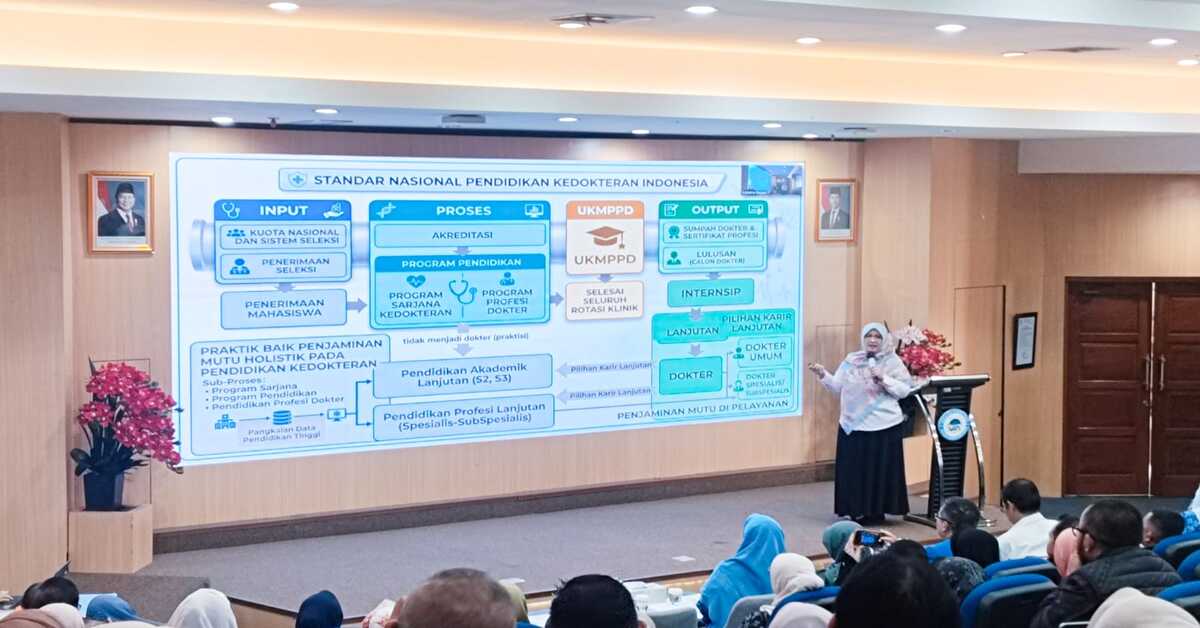
Prof. MK. Tadjudin Auditorium, FK UIN Jakarta News Online — During an academic system orientation session at the Faculty of Medicine (FK) UIN Jakarta, Vice Dean for Academic Affairs Dr. dr. Fika Ekayanti, M.Med.Ed., introduced parents and guardians to the overall medical education pathway, from the beginning to the end of the academic journey. The session aimed to educate parents and raise awareness of their role in understanding and supporting their children’s educational progress as FK UIN Jakarta students. The orientation was held at Prof. MK. Tadjudin Auditorium on Thursday (September 11, 2026).
At the beginning of her presentation, Dr. dr. Fika Ekayanti explained that FK UIN Jakarta offers the Program Beasiswa Santri Berprestasi (PBSB), a scholarship pathway that has received particular attention. The program was established to support Islamic boarding school students in pursuing careers as doctors. FK UIN Jakarta also offers admission pathways through scholarships such as Beasiswa Indonesia Bangkit (BIB) and the Indonesia Endowment Fund for Education (LPDP).
“We would like to emphasize that outstanding santri are among those we also prioritize,” she stated.
In line with this, Dr. dr. Fika explained that medical and specialist education at FK UIN Jakarta continues to develop. The faculty is expanding its advanced education programs, including specialist programs in pulmonology and obstetrics and gynecology, as well as a biomedical sciences program. These developments allow students to broaden their educational networks at FK UIN Jakarta. However, students who wish to pursue further studies are required to maintain a minimum GPA above 2.00.
Evaluation stages are also conducted throughout the students’ educational journey. These evaluations assess not only academic performance but also students’ ability to adapt to and follow the educational process. If a student is considered unable to meet the required standards, the faculty will conduct evaluations in the second and fourth semesters, followed by monitoring in subsequent semesters to determine whether the student should be dismissed from the program.
“We hope that we, as representatives of the faculty, will meet parents and guardians only during the initial semester orientation and later at the physician’s oath ceremony. Because if we meet in between, it means there is a problem,” she said lightheartedly.
She further explained that FK UIN Jakarta does not solely focus on student evaluations. The faculty also provides supporting units for students’ educational activities, including Medical Education, Medical Research, the Community Service Unit, Clinical Skills, and the Center for the Prevention and Handling of Sexual Violence (KP3KS), as well as counseling services.
Dr. dr. Fika also emphasized the importance of support from those closest to students throughout their medical education. She highlighted the role of Academic Advisors (PA), who serve as the primary point of contact for students when raising concerns with faculty members. She also encouraged parents and guardians to find out who their children’s Academic Advisors are.
“After a complaint is submitted to the Academic Advisor, the advisor can refer it to the appropriate unit. If counseling support is needed, the Academic Advisor will refer the matter to the KP3KS unit. The unit will then communicate with the study program and, ultimately, the dean’s office,” she explained.
As Vice Dean for Curriculum Affairs, Dr. dr. Fika addressed students’ occasional questions about why they were still studying certain subjects within the specialized How to Learn curriculum. She explained that medicine studies the whole human being, not merely the physical body. A person’s background can influence how a disease manifests, meaning that similar underlying circumstances may result in different clinical presentations.
“Medicine cannot be studied alone; it cannot be pursued in isolation. In my view, doctors can be difficult to manage because they have a high degree of independence. This is something we need to communicate gradually through education. Education is like farming: it must be carried out continuously and diligently before the results become visible,” she explained.
“Therefore, students need to understand patients as whole human beings,” she added.
Looking ahead to life after graduation, Dr. dr. Fika also discussed the various career paths available to medical graduates. Graduates are not limited to becoming doctors or clinical practitioners. They may also pursue careers as academics, researchers, administrators, or biotechnology developers. In addition, entrepreneurship and health influencing are among the fields that medical graduates may explore.
These opportunities are supported by FK UIN Jakarta’s curriculum, which integrates learning from basic sciences to clinical education. The curriculum includes general education, organ systems, pathological systems, and clinical reasoning. In the final semester before entering the clinical stage, students undergo preparation and a comprehensive examination.
Concluding her presentation, Dr. dr. Fika encouraged parents and guardians to continue providing support, motivation, and encouragement to their children throughout their medical education. She noted that medical students have demanding schedules, as reflected in their academic workload, which can reach up to 70 credit hours (SKS).
(MA/NIS)