
Narrative as Power: dr. Gia Pratama Highlights the Role of Doctors in Creating, Storytelling, and Influencing Society
- 07 February 2026
- 2 min read
- 3369
-

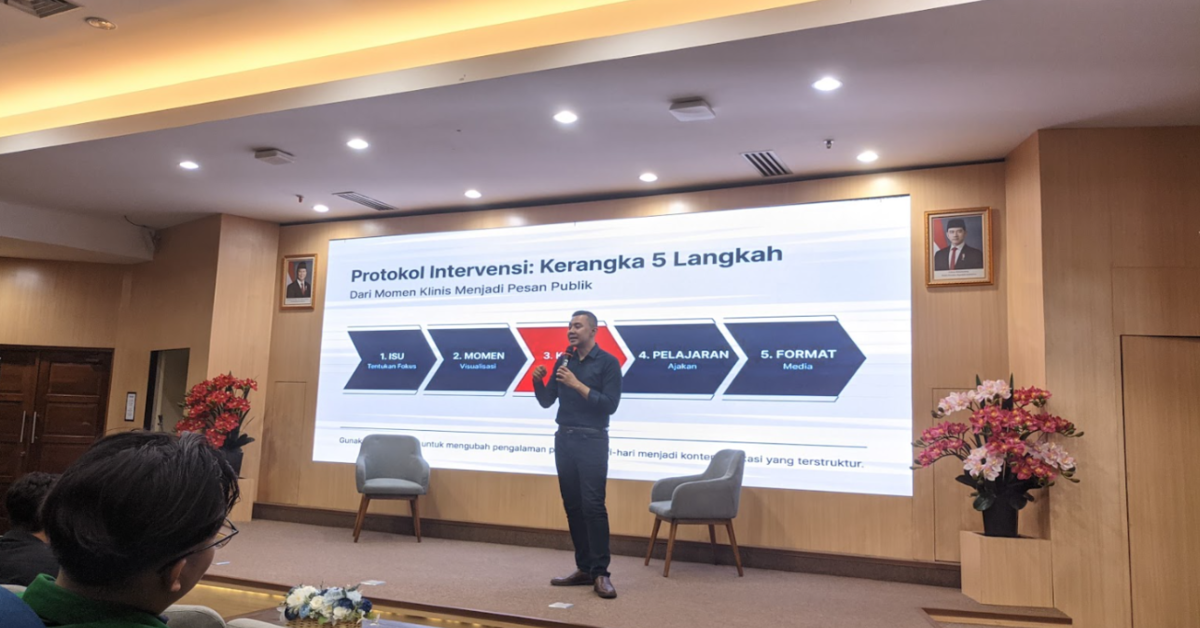
Auditorium M.K. Tadjudin, Faculty of Medicine UIN Jakarta — dr. Gia Pratama emphasized the importance of storytelling and narrative-building as part of a doctor’s role in influencing public behavior and health awareness. He delivered this message during a presentation session at the National Leadership and Student Management Training (LKMM) 2026 organized by the Indonesian Medical Student Senate Association (ISMKI) 2025/2026 on Friday, 7 February 2026. The session took place on the third day of the event at the M.K. Tadjudin Auditorium, Faculty of Medicine UIN Syarif Hidayatullah Jakarta.
In his presentation, dr. Gia explained that doctors’ medical competencies need to be combined with the art of writing and storytelling so that health messages can be effectively received by the public. According to him, understanding is the key factor before people are encouraged to change their behavior.
“Our competencies must be combined with the art of writing. When people understand, they become more relaxed, more confident, and only then will they take action,” he said. He noted that people’s decisions to exercise, maintain healthy eating habits, or adopt a healthy lifestyle typically arise after they truly understand the reasons and benefits behind these actions.
However, dr. Gia pointed out that many senior doctors with extensive expertise often struggle to communicate their knowledge in simple and accessible ways. Despite their vast knowledge, he noted that its potential benefits for the wider community are sometimes not fully realized.
“Many doctors are highly skilled in their fields and possess extraordinary knowledge, yet when they speak, not many people truly understand,” he explained. He suggested this may occur because the material presented is too complex or not simplified according to the audience’s context.
As a result, health messages that should serve as references are not effectively delivered. dr. Gia described this situation as information that sounds vague and unclear, creating space for miscommunication and misinformation to spread in society.
“The voice that should carry great meaning ends up sounding like mere noise, while miscommunication spreads smoothly at the same time,” he added.
Through this session, dr. Gia encouraged medical students to develop not only their clinical competencies but also their communication and narrative skills. He emphasized that doctors hold a strategic position as trusted public figures, making the ability to convey health messages effectively an essential part of medical professionalism.
(RGN/NIS)